What Nobody Tells You After a Construction Site Injury (And What That Silence Costs You)
What Nobody Tells You After a Construction Site Injury (And What That Silence Costs You)
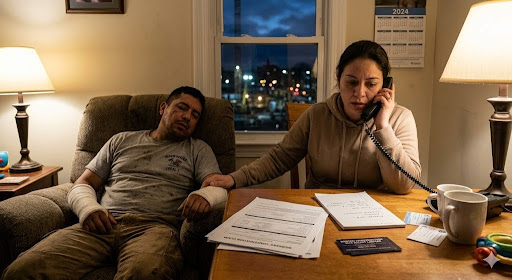
The call I remember most clearly came in on a Tuesday night, just after ten. A woman—wife of an ironworker who’d fallen from scaffolding three days earlier—was whispering because her husband was finally asleep in the next room. She’d already talked to the foreman. She’d already talked to someone from the insurance company. She was calling me because something felt wrong, and she couldn’t name it yet.
Her husband had given a recorded statement the morning after the accident. Still on pain medication. Still not sure what he’d said.
That’s the moment I keep writing for.
By the time most families find their way to someone who can actually help them, they’ve already made one or two of the mistakes that quietly shrink what they’re owed. This article is about those mistakes—and more importantly, about the window you still have to avoid them.
The Same Injury. Two Completely Different Outcomes.
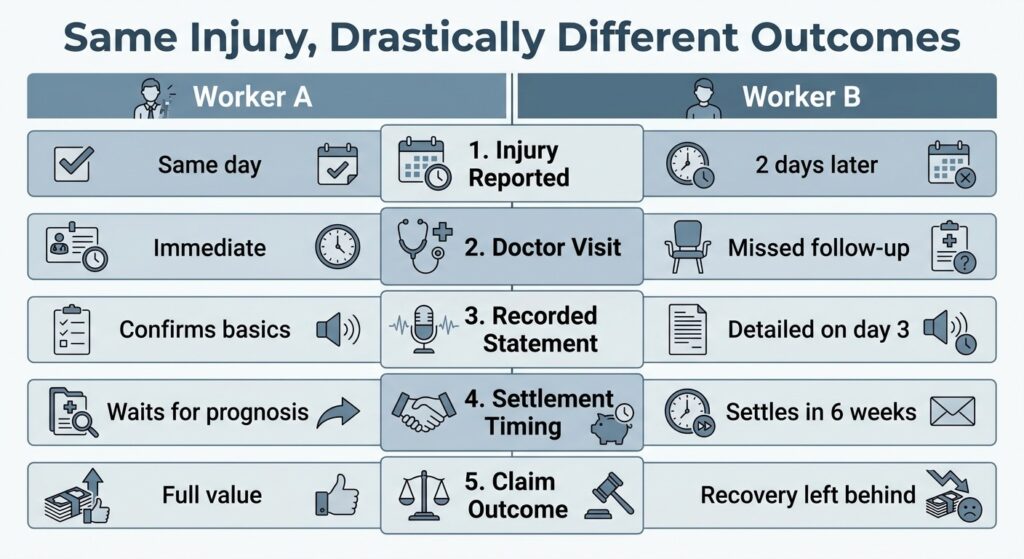
Picture two versions of the same fall. Same site, same broken bones, same morning in the ER.
| Worker A | Worker B | |
|---|---|---|
| Reporting | Reports in writing the same day | Waits two days because foreman said “see how it feels” |
| Medical | Sees a doctor immediately, keeps every appointment | Misses a follow-up trying to push through |
| Statement | Confirms date and location only | Gives detailed recorded statement on day three |
| Settlement | Waits for full prognosis | Accepts offer at six weeks because bills are mounting |
| Outcome | Full claim value preserved | Significant recovery left on the table |
Same injury. Completely different outcomes. The gap between them isn’t luck, and it isn’t about being smarter or tougher. It’s about knowing—before the phone rings—what the system is actually designed to do.
What Workers’ Compensation Actually Is (And What It Isn’t)
Most injured workers think workers’ compensation is their employer’s way of taking care of them.
It isn’t.
It’s an insurance system, and the adjuster on the other end of the line works for that insurance company—not for you. Workers’ compensation covers medical treatment and a portion of lost wages when you’re injured on the job. That’s real, and it matters. But it has hard limits: no coverage for pain and suffering, no accounting for the full scope of long-term disability the way a civil claim might, and a structure that won’t pursue other liable parties on your behalf.
Here’s what that last point means in practice. Construction sites typically involve multiple parties: a general contractor, subcontractors, equipment manufacturers, property owners. If someone other than your direct employer contributed to the conditions that caused your injury—a subcontractor who left a hazard unmarked, a manufacturer whose equipment failed—you may have a third-party liability claim entirely separate from workers’ compensation. That claim can include damages workers’ comp never touches.
This is where consulting a boston construction site injury lawyer becomes relevant not as a luxury but as a practical necessity. The value of a third-party claim depends on facts that need to be preserved early: site conditions, equipment records, OSHA documentation, witness accounts. Wait too long, and those facts disappear.
One more thing most injured workers never know: if a safety violation contributed to your injury, an OSHA report creates an independent record that can support your claim in ways your own account cannot. You have the right to report unsafe conditions. You have the right to request inspection records. Use them.
The 72-Hour Window You Cannot Afford to Miss
Construction falls have averaged approximately 300 fatal and 20,000 nonfatal injuries per year since 2013. Those aren’t abstractions—they’re real workers navigating a claims process that rewards documentation and punishes delay.
The reporting window matters legally. Most states require injury reports within a specific number of days, and missing that window gives an insurer grounds to deny or reduce your claim. But the practical window is even shorter. The first 48 to 72 hours are when evidence is freshest, witnesses remember clearly, and site conditions haven’t been altered.
Do these things, in this order:
- Report in writing. Not just verbally, not just to your foreman. Get something on paper with a date.
- See a doctor the same day if at all possible. Tell them every symptom, even the ones that seem minor. What you don’t report on day one becomes “pre-existing” or “unrelated” on day sixty.
- Photograph everything you can access: the site, the equipment, your injuries.
- Write down what happened in your own words while it’s fresh—not for the adjuster, just for yourself.
Your medical records become the spine of your claim. Every appointment you skip, every symptom you downplay, every follow-up you miss because you’re trying to be tough—those gaps become arguments against you. I’ve seen adjusters use a single missed appointment to argue that an injury “couldn’t have been that serious.” Don’t give them that.
Three Myths That Cost Workers Real Money
Myth 1: “I have to cooperate fully with the insurance adjuster.”
You have to report the injury and provide basic factual information. You do not have to give a recorded statement, and you are not required to speculate about fault, describe your pain in detail, or answer questions about your medical history before you’ve spoken with anyone who represents your interests. Adjusters are trained to ask open-ended questions that invite answers that can be used to minimize your claim. “Cooperating” does not mean answering everything.
Myth 2: “Workers’ comp will cover everything I need.”
It covers a defined set of benefits. It does not cover the full wage replacement most families need, it doesn’t address pain and suffering, and it won’t pursue a third-party claim on your behalf. If a scaffold collapse happened because of a subcontractor’s negligence, workers’ comp pays your medical bills while a potential civil claim sits uncollected.
Myth 3: “I should settle quickly and move on.”
I understand why people feel this way—the bills don’t stop, the income has. But falls from height represent roughly 81% of fatal construction falls, and they often produce injuries with long recovery arcs and delayed complications. Settling before you know the full extent of your injuries means settling for less than you’ll actually need. The first offer is rarely the real offer. Insurance adjusters typically counter rather than accept initial demands, which means there’s almost always room you’re leaving behind.
How the Timeline Works Against You
The weeks immediately after a construction injury are when the most consequential decisions happen—and when injured workers are least equipped to make them. You’re in pain. You’re worried about your job. You’re getting calls from people who sound official and helpful.
Here’s what that timeline looks like from the other side:
- Days 1–3: Adjuster contacts you quickly. Early contact produces statements before you’ve understood your rights. They may sound sympathetic. They may frame the settlement conversation as doing you a favor.
- Weeks 1–2: Medical picture is still incomplete. Long-term prognosis unknown. Any settlement signed here is signed blind.
- Weeks 3–6: Pressure increases as bills accumulate. This is when most premature settlements happen.
- Beyond 6 weeks: The factors that actually determine claim value—severity, long-term medical needs, lost earning capacity, third-party liability—are finally becoming clear. This is when you’re actually equipped to negotiate.
Construction consistently ranks among the most dangerous industries in occupational fatality data. Insurers know the claims are serious and move accordingly. The question is whether you move with the same urgency—in the right direction.
If you’re being pressured to sign anything, the right response is simple: “I need to review this with an attorney before I sign.” That sentence costs you nothing and protects everything.
The Questions Families Are Actually Asking
Did I wait too long to report? Maybe, but probably not as long as you fear. Report now, in writing, and document why there was a delay. A delay weakens a claim; it doesn’t end one.
I already gave a recorded statement. Is it over? No. What you said matters, but context matters too, and a recorded statement isn’t a confession. What happens next still depends on your medical documentation, your consistency in treatment, and whether other liable parties exist.
My employer is being really nice about it. Should I trust that? Your employer’s kindness and your employer’s insurance company’s interests are two different things. The adjuster doesn’t work for the person who hired you. Be respectful, be factual, and be careful.
What if I can’t afford a lawyer? Personal injury lawyers handling construction cases typically work on contingency—meaning they take a percentage of what they recover, not an upfront fee. The consultation is usually free. The cost of not talking to one is often far higher than people realize.
Construction workers account for nearly half of all fatal occupational falls across every industry in the country. The system that processes those injuries was not designed with your interests as the priority. That’s not cynicism—it’s just the reality of how insurance works.
What You Actually Need Right Now
You don’t need to have everything figured out. You need to stop the bleeding on the mistakes that are hardest to undo.
Stop. Do these four things:
- Report the injury in writing if you haven’t
- Keep every medical appointment and tell your doctors everything
- Don’t give recorded statements without understanding what you’re agreeing to
- Don’t sign any settlement documents until you know your long-term prognosis and whether a third-party claim exists
Then talk to someone who handles these cases before you make any major decisions. Not because you’re committed to suing anyone. Not because you’re looking for a big payout. Because you deserve to understand what you’re actually entitled to before you agree to less.
That’s it. That’s the whole thing.
The system counts on you being too overwhelmed to ask these questions. You’re asking them now. That already puts you ahead of where most people are when they call me.